

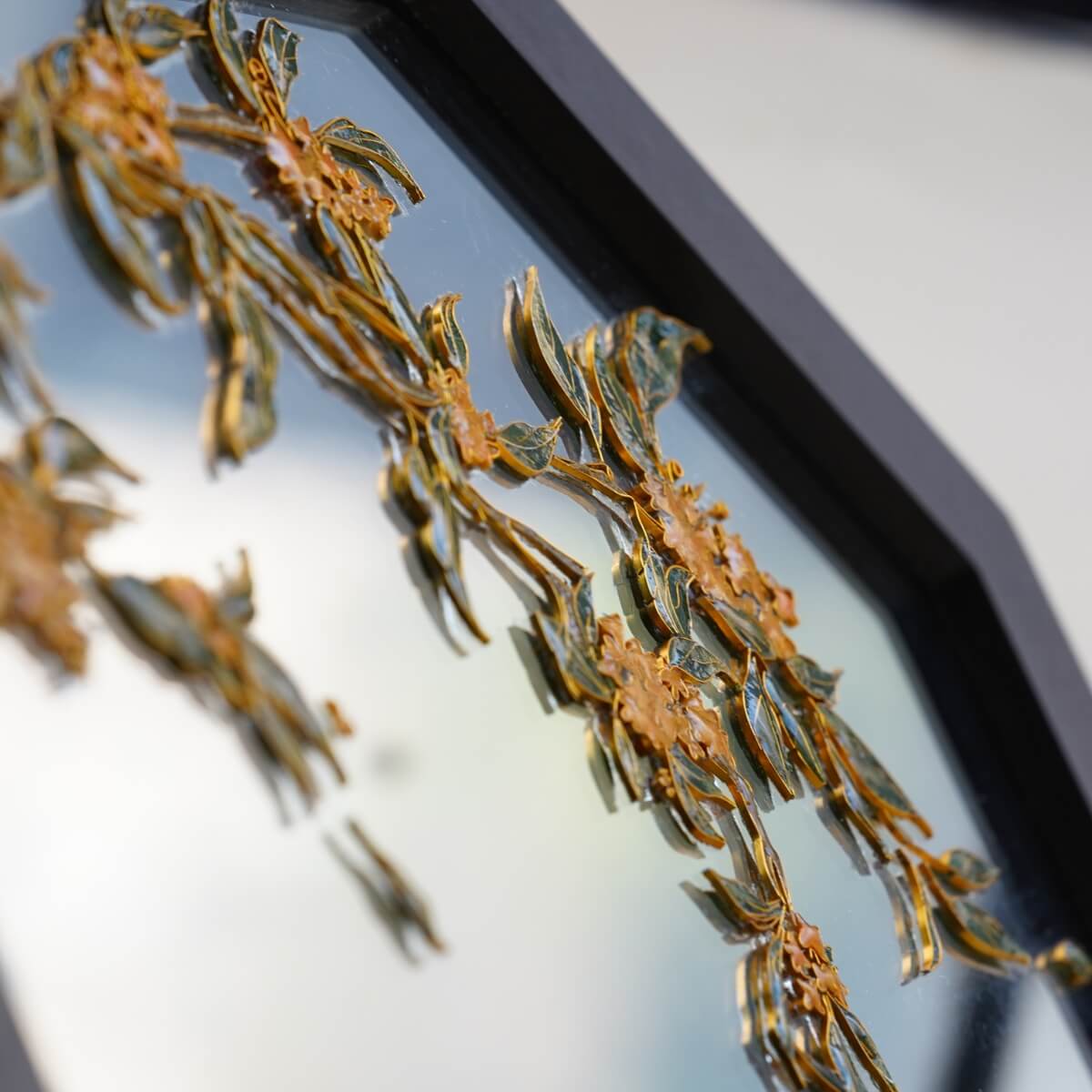
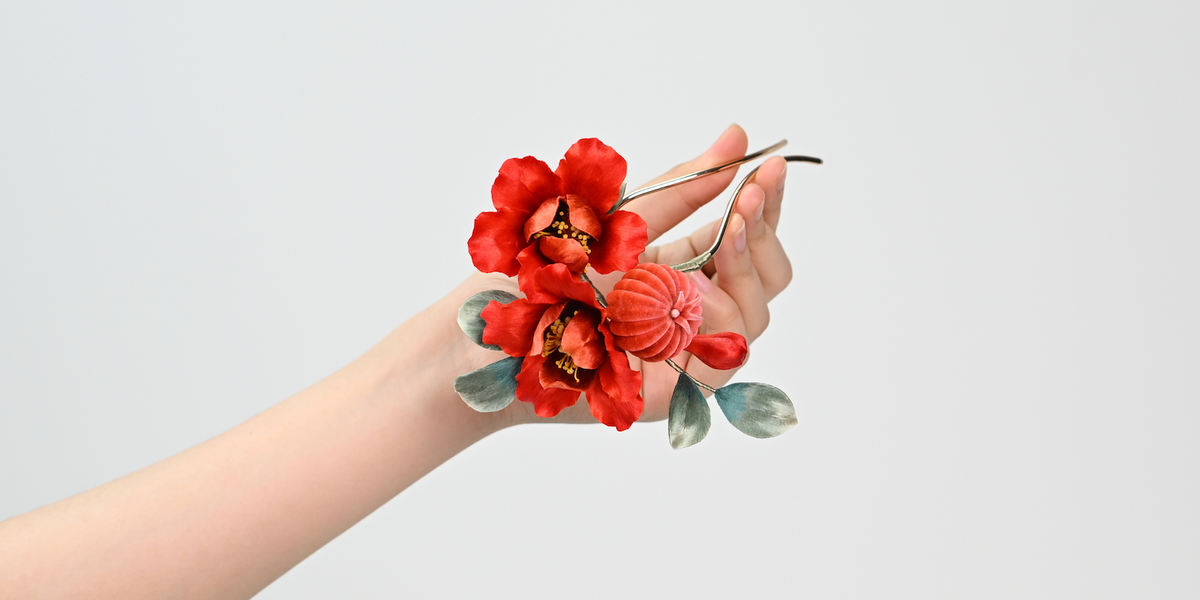
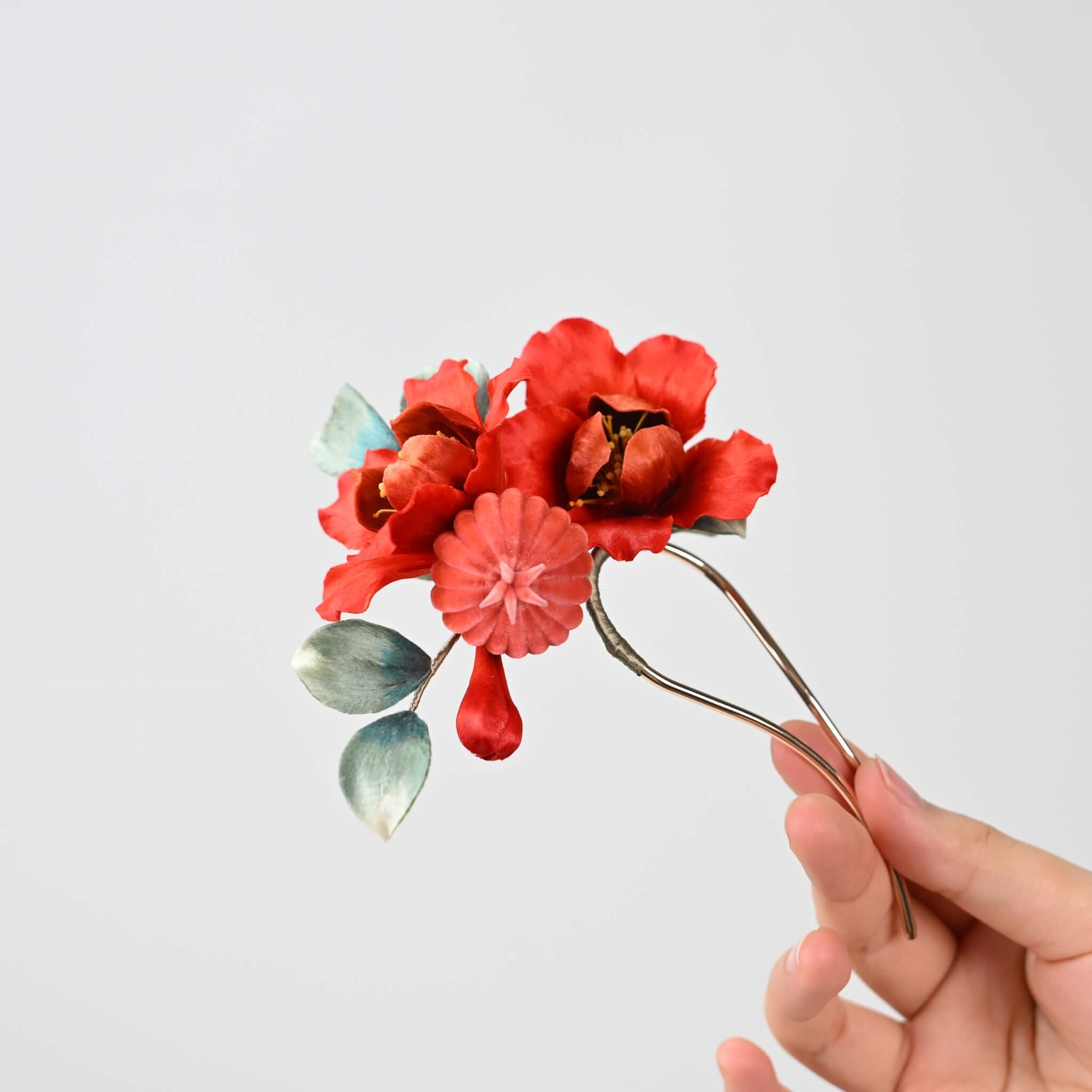
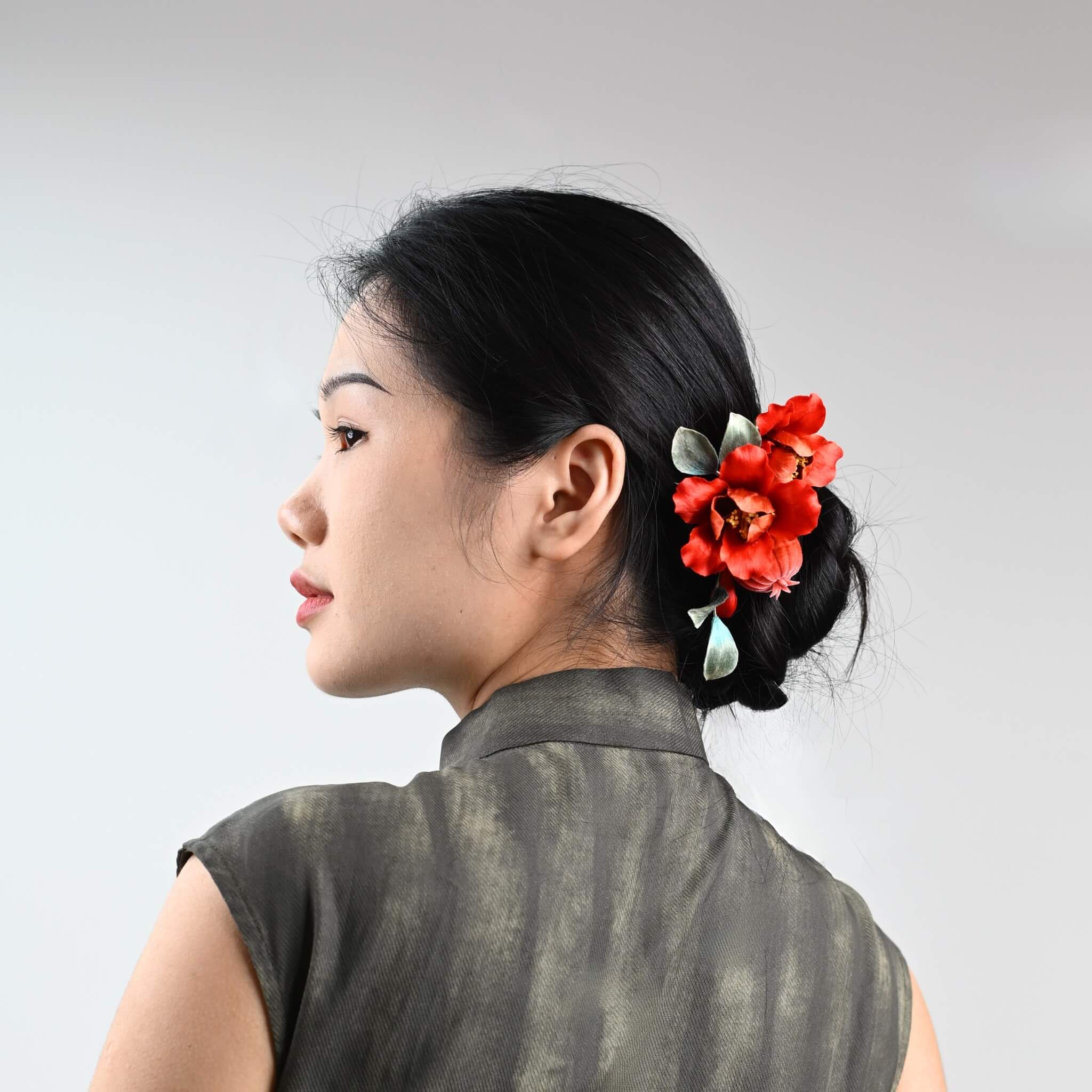
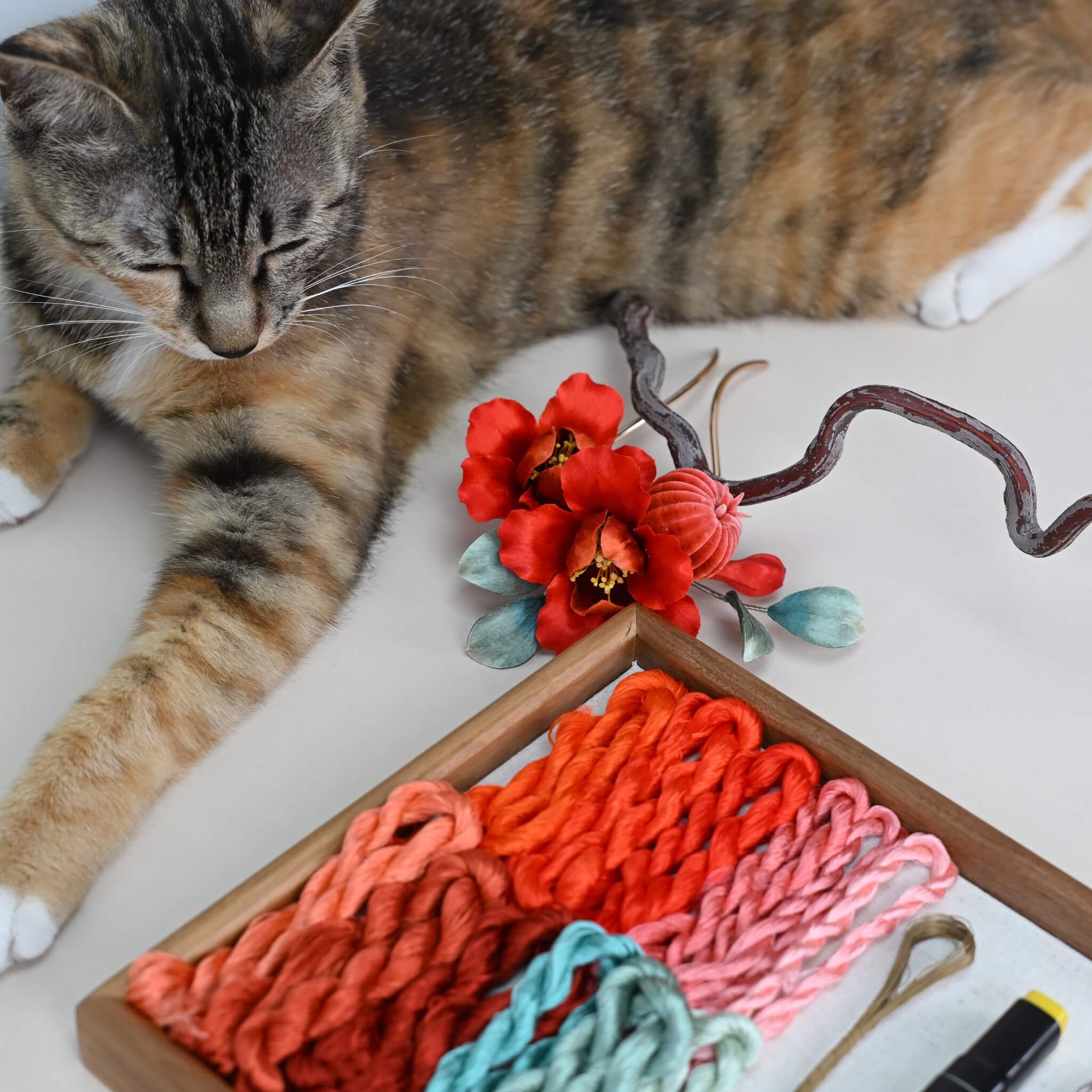
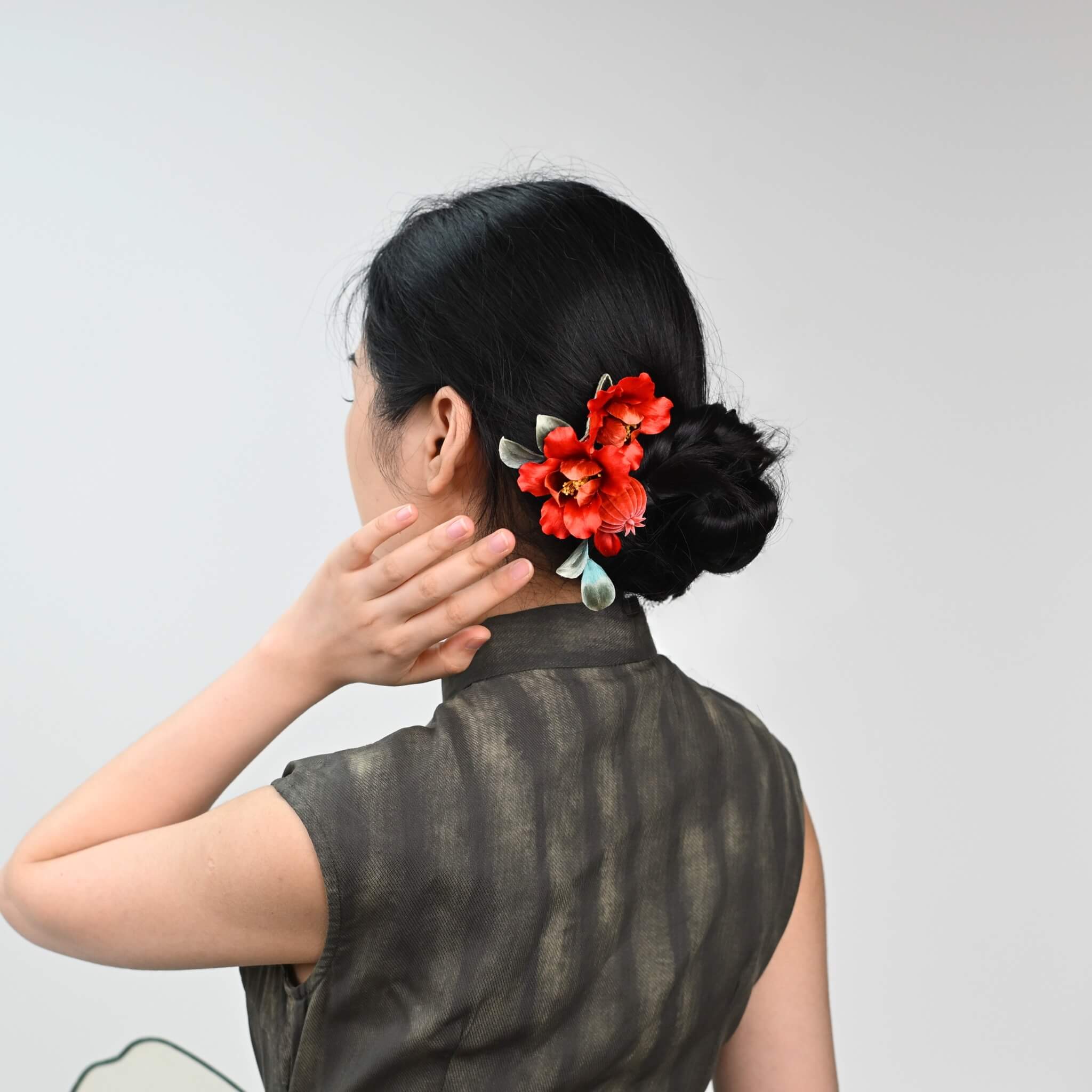
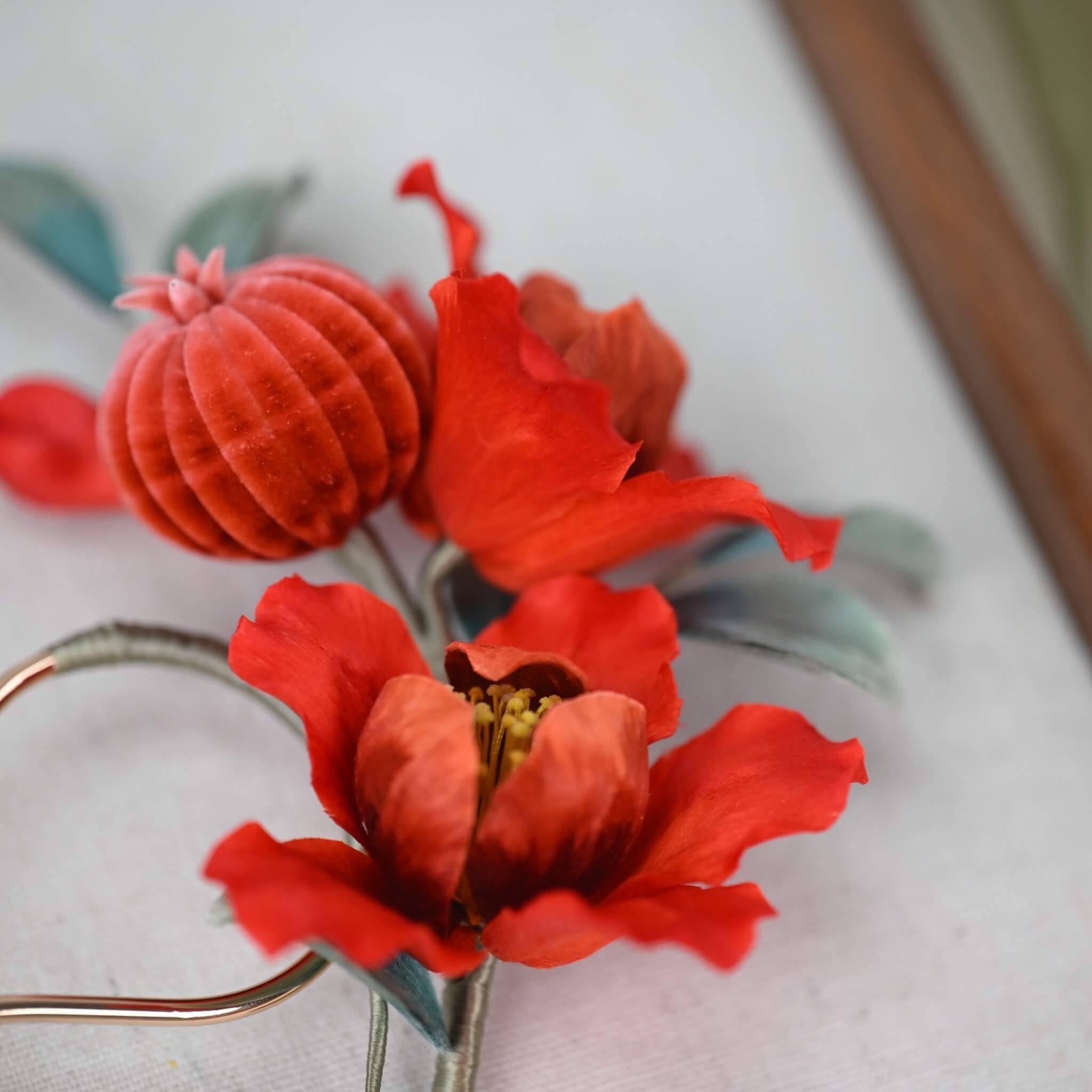
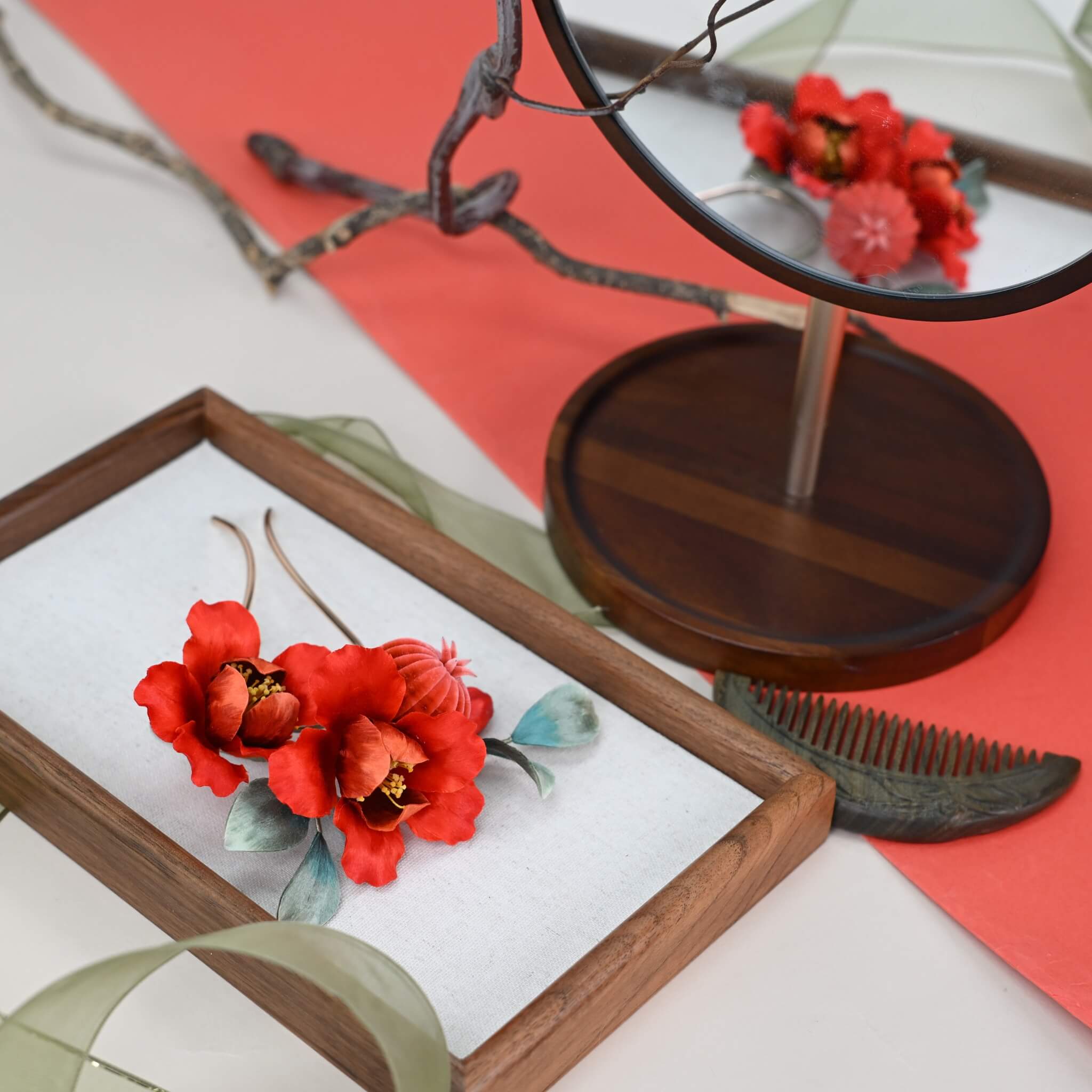
This pomegranate-flower hairpin combines delicate silk flowers, a round pomegranate fruit, and graceful leaves into an elegant traditional-inspired hair accessory. With layered orange-red petals, fine silk details, and carefully wrapped stems, the finished piece has a warm, vibrant look that makes a beautiful statement in the hair.
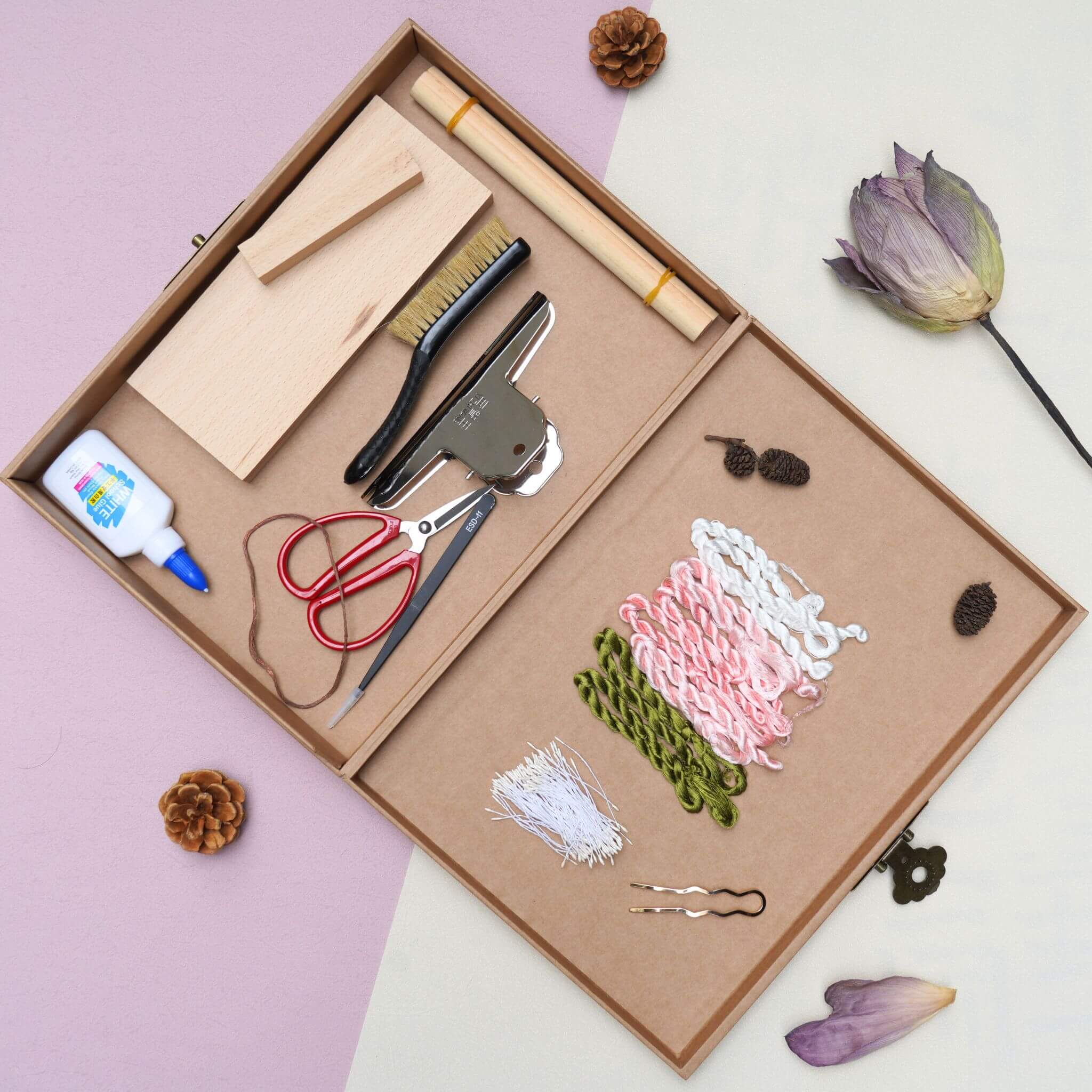
Preparation: What You’ll Need
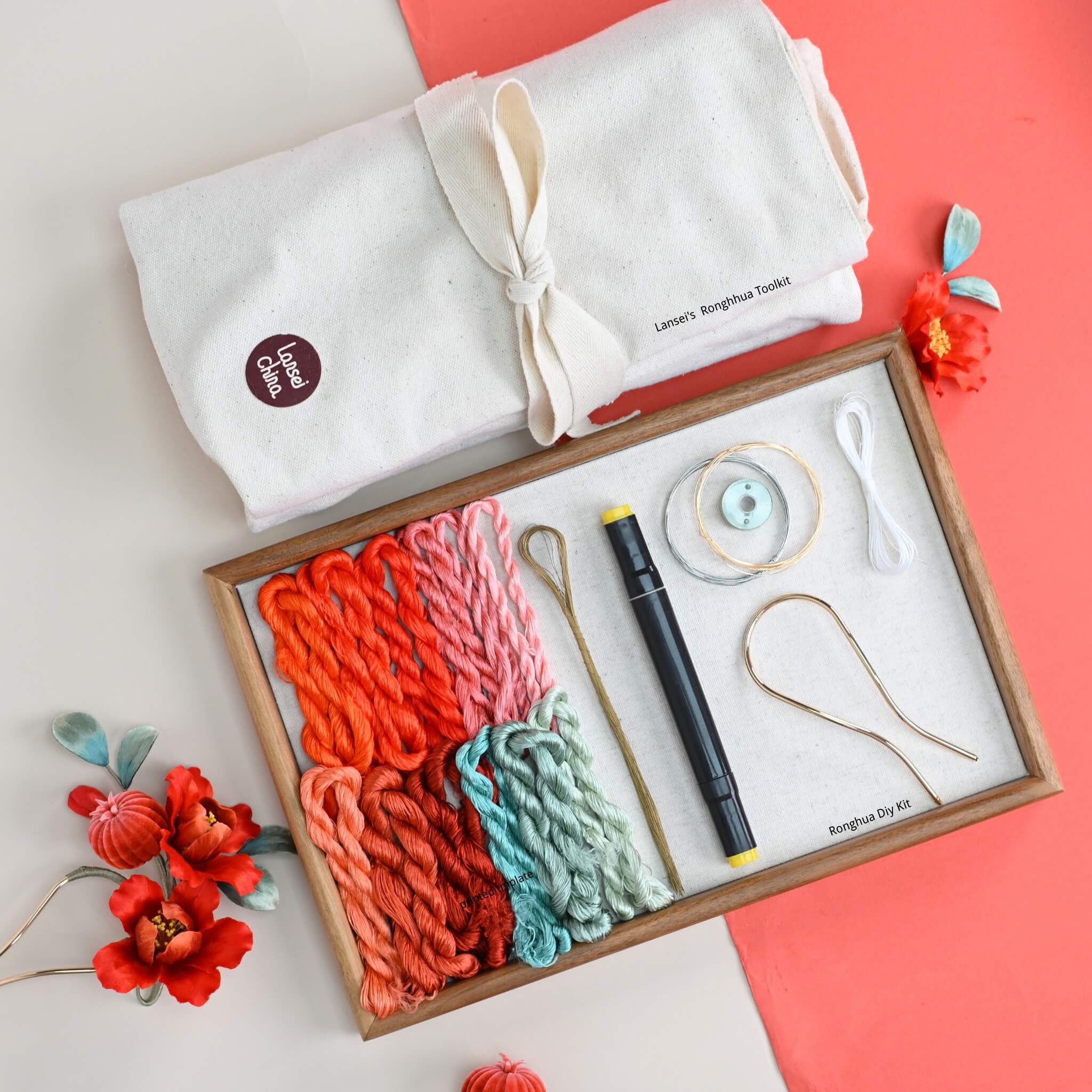
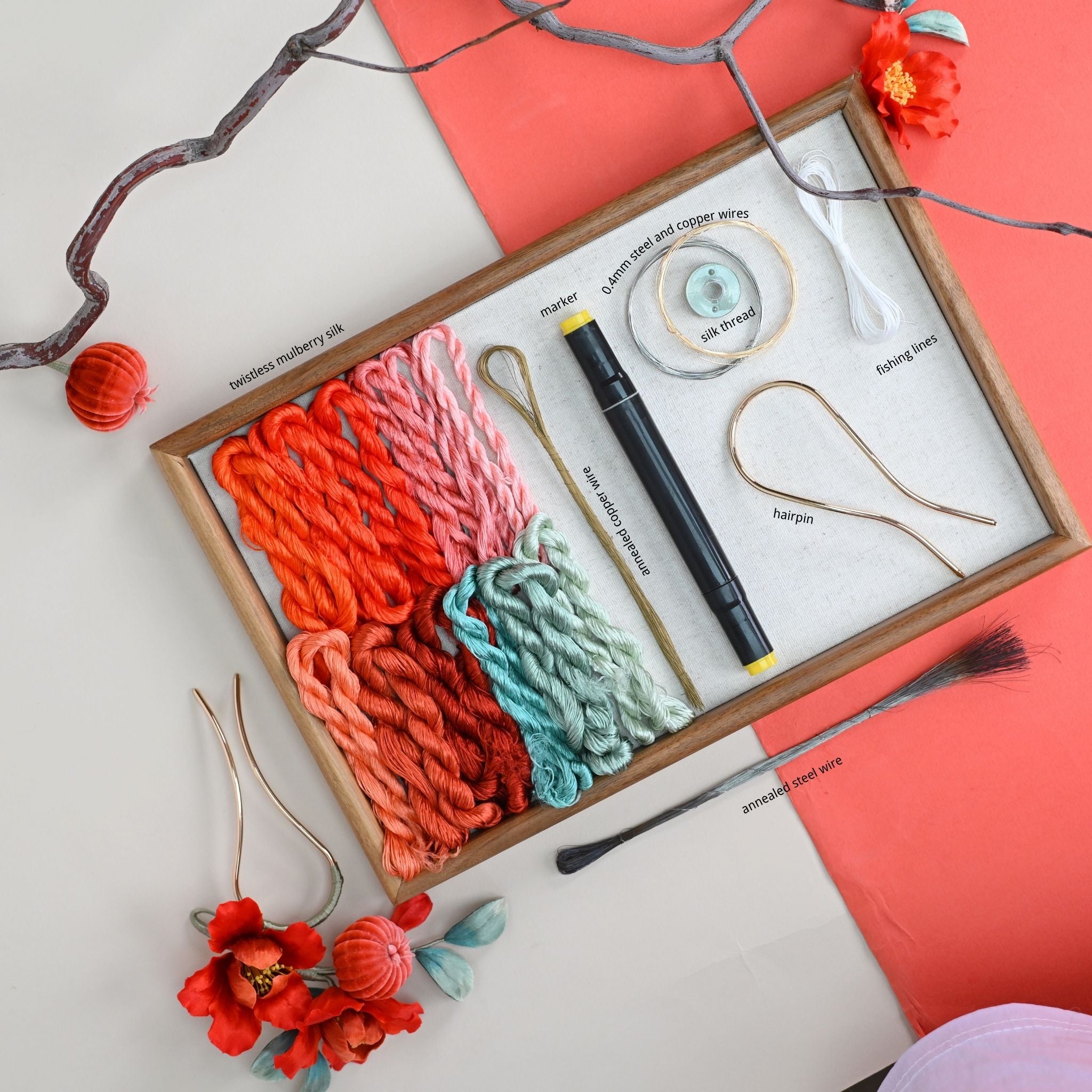
If you’ve purchased our Ronghua Toolkit, you already have everything required!
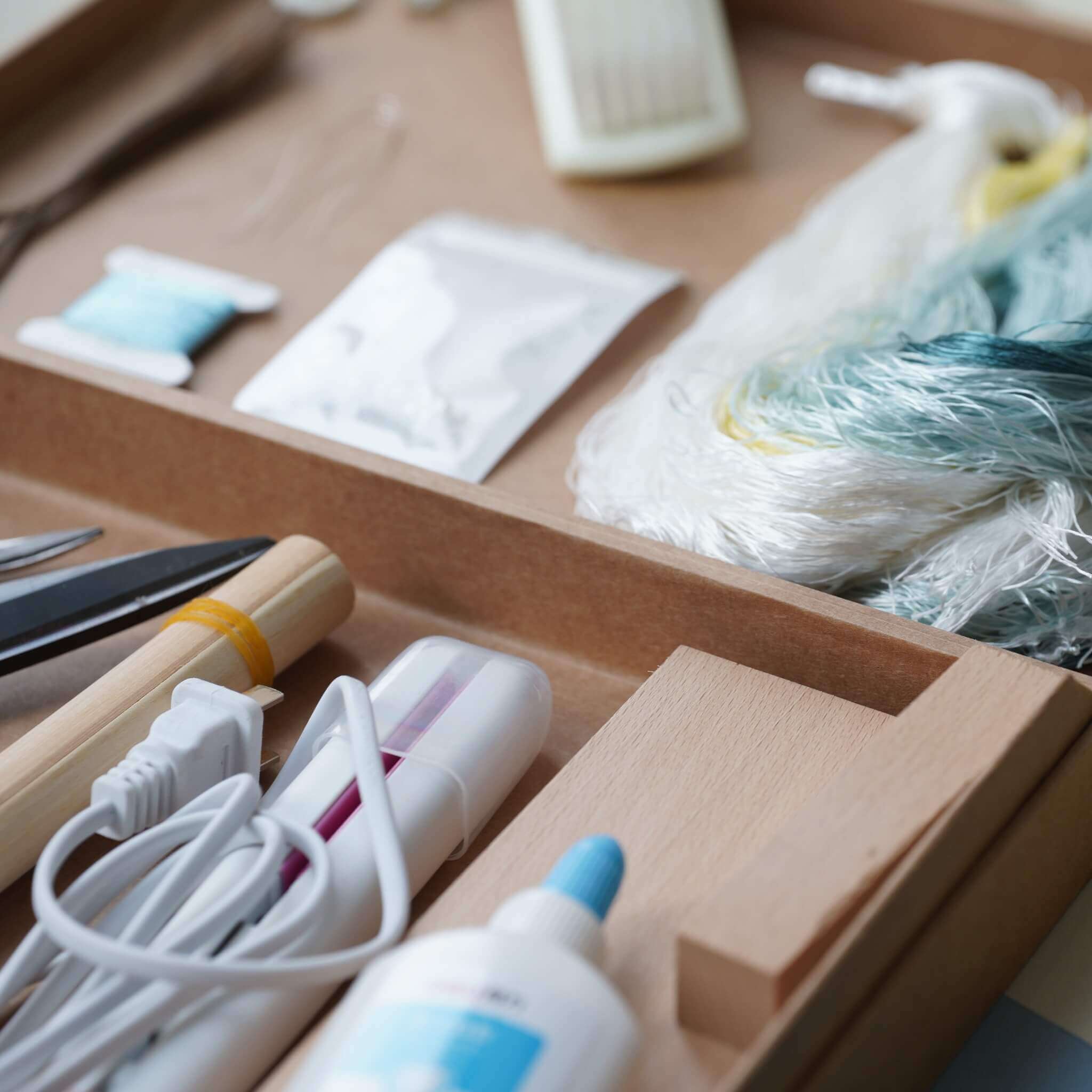
If not, prepare the following tools:
- Bristle brush (Medium to soft hardness)
- Flat iron (the one you use to straighten your hair)
- Tweezers
- At least 2 pairs of Scissors
- wooden sticks / pencils / chopsticks
- Hair spray or diluted white glue (1:1.15–1:1.2 ratio)
- Big clips (around 15cm)
- Twisting boards and wooden blocks (for even tension)
- Anti-slip powder (optional but helpful)
Full Tutorial Video
Step. 1 Align and Arrange the Silk Threads
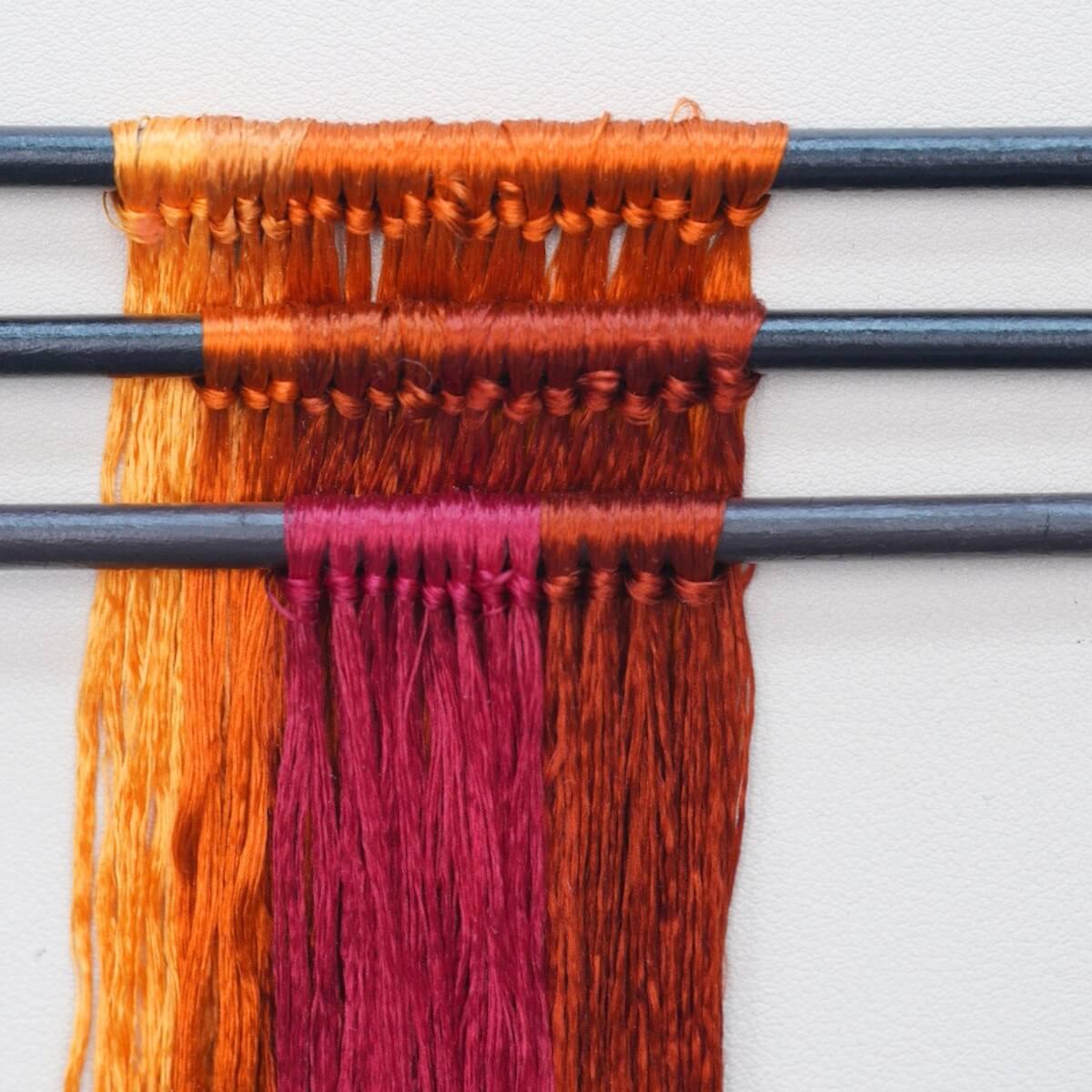
Begin by untying your silk threads and locating the knot at one end of each bundle. Carefully cut the knot open and ensure all strands are straightened. Group and separate your silk bundles based on the color palette required for the orange-red petals, green foliage, and yellow stamen accents.

Step. 2 Group and Prepare the Threads
Each silk bundle is composed of many tiny individual strands. Align these strands carefully and tie them around a small stick or pencil, ensuring the ends are perfectly flush. Keeping the lengths even is vital for a consistent texture during the brushing process.

Step. 3 Make Silk Rows
Proceed to group the threads into distinct rows. You will need to prepare separate rows for the petals, leaves, fruit body, and calyx. Ensure that each row is organized according to the color gradients and sizes specified in your project layout.

Step. 4 Brush the Silk
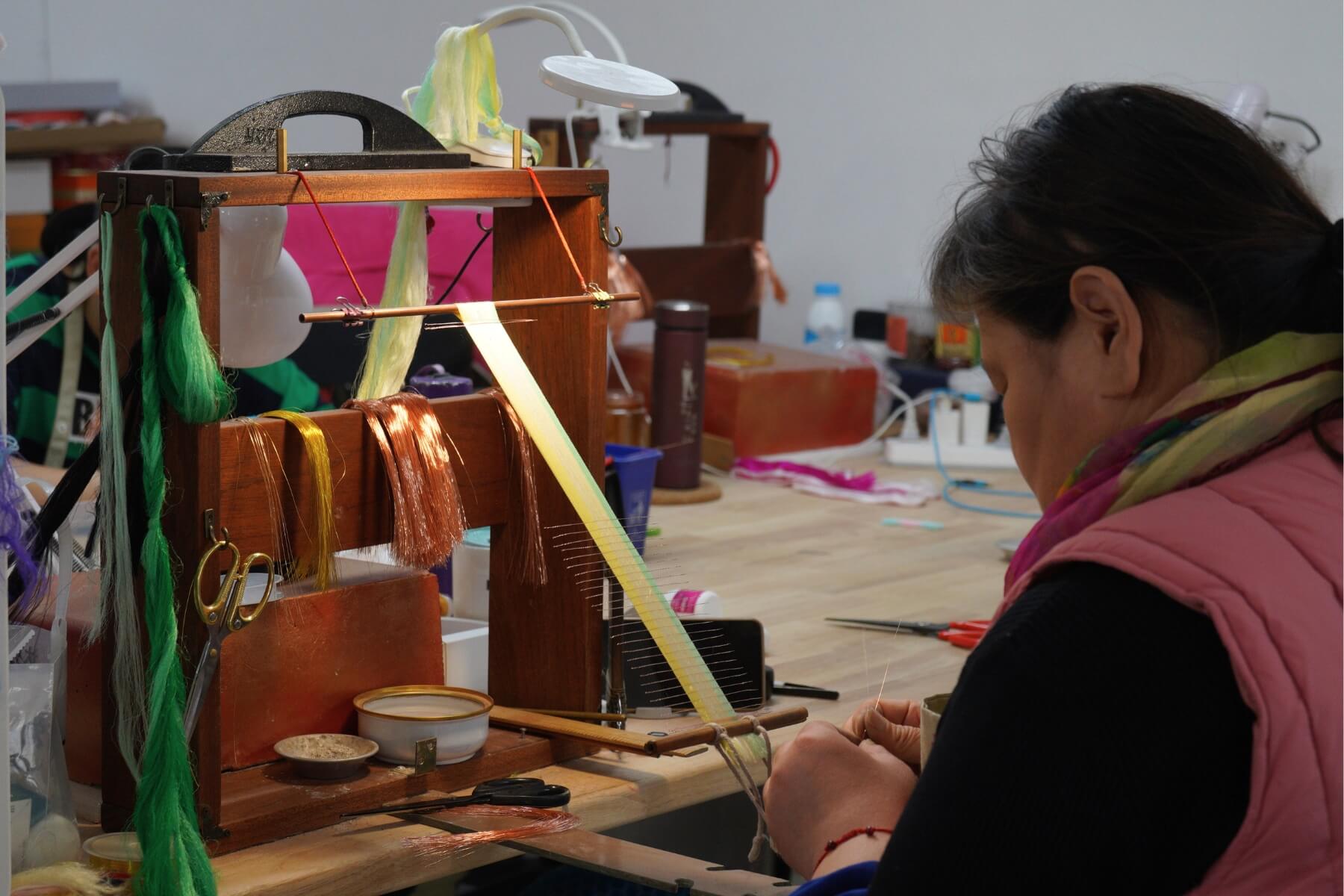
Attach your silk rows securely to a stand or a flat surface. Using a bristle brush, comb the silk thoroughly from top to bottom.

Continue brushing until the silk is completely smooth, fluffy, and free of any tangles. If the silk becomes static, mist the surrounding air lightly with water.

Step. 5 Attach Copper Wires
When you feel that the silk is brushed enough, secure its tail with another big clip to your table or anything that can help stretch it taut. Take out one copper wire from the folded end of the row and straighten it. Twist the folded part into a spiral of about 3 cm. Clamp the silk threads between two copper wires and twist the opposite side tightly. Pull both wires taut and continue twisting until they merge into one.
Remember, the twisting direction for the left and right end are opposite. The spacing should be the same as shown in step 1.
Please be sure to make the copper wires exactly the distance shown in the diagram and pay particular attention to the thinnest silk strips (with distance 7mm between copper wires). Otherwise, issues will arise when assembling them into the pomegranate fruit shape.
You can watch our video tutorial for this step:)
Step. 6 Cut the Silk Strips
Using a pair of scissors designated for silk, trim away the excess thread from the row ends. Cut through the silk exactly in the middle of each wire twist to separate the row into individual silk strips. Never use these scissors on copper wire, as this will dull the blades and cause the silk edges to fray.

Step. 7 Center and Twist the Strips
Lay each silk strip on a flat surface and ensure the copper wire is perfectly centered.

Twist the wires by hand to tighten the grip on the silk, then place the strip between two twisting boards. Roll the boards firmly to twist the wire until it is tightly embedded and nearly invisible within the silk.

Step. 8 Shape the Silk Strips
Fold all silk strips in half, aligning the left and right sides evenly, and trim away any messy or fuzzy sections. Cut three orange-red strips in half to create six short pieces for the flower bud petals. For the remaining orange-red strips, fold them in half and use tweezers to gently lift each strip upward, slightly narrowing the center gap. Press and flatten all petal strips with a heated flat iron, always working systematically from the back toward the front.


Dip each flattened silk strip into unscented hairspray, using tweezers to squeeze out all excess liquid so the finished petals do not become overly thick.

Stand the strips upright in foam, a sponge pad, or a bristle brush to dry completely. For the main petals, use tweezers to gently pinch the base inward, turn the upper portion slightly outward, and press soft wavy curves into the edge fibers.

For the inner petals, shape each into a gentle curve and push the edge fibers inward to create small, subtle folds.

For the leaves: Bend each leaf strip into a gentle curve, then push the silk fibers along the edges slightly in the opposite direction of the main bend. Refine the tip of the leaf so it is fairly pointed, then insert the finished leaves upright into foam to dry.

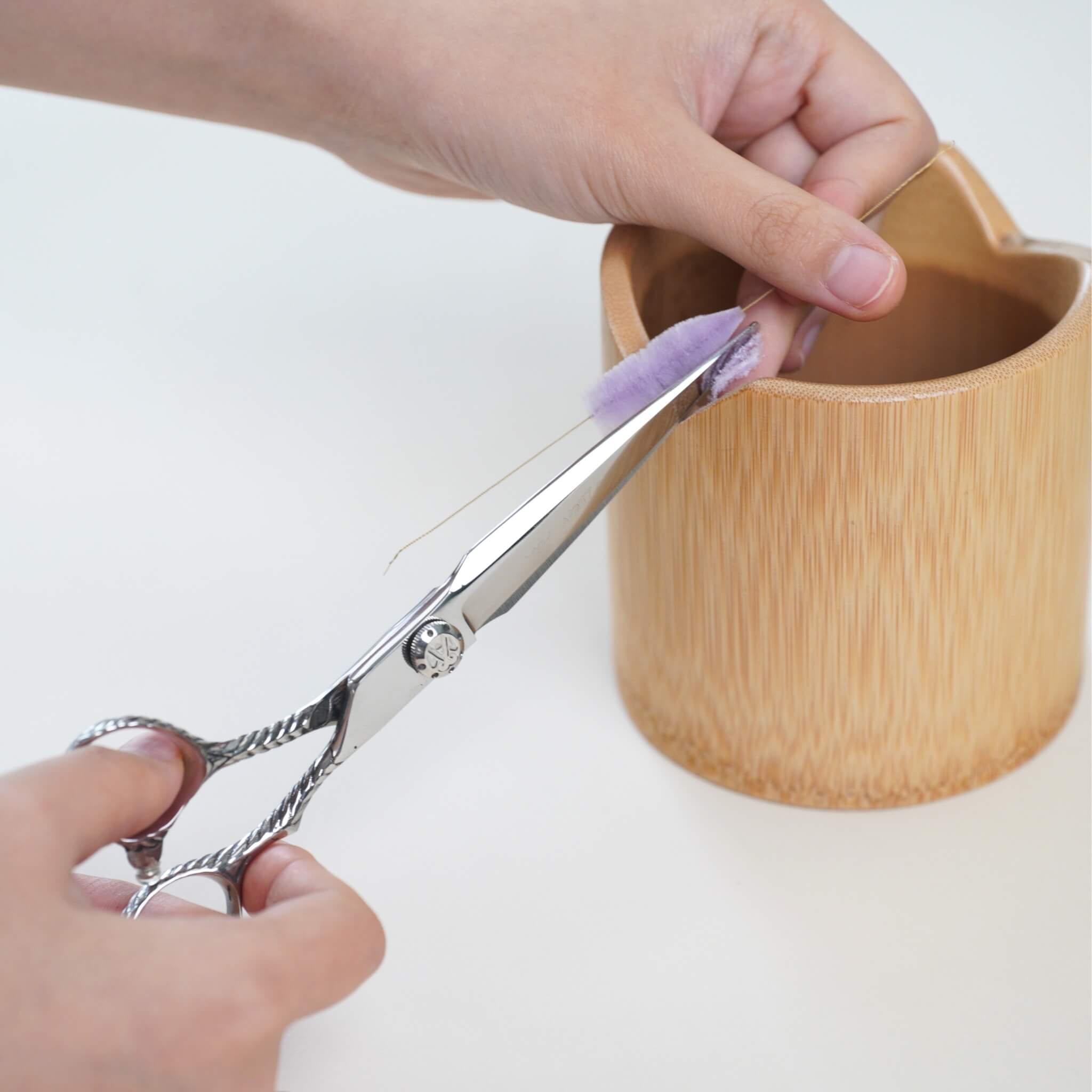
Set aside five fine silk strips for the calyx and use the remaining 20 fine strips for the fruit body. Rest each fruit strip against the notch in a bamboo holder and rotate it against the scissors to trim both ends into a tapered shape that is widest in the center and narrow at the tips.

For the five calyx strips, trim them down to 1 cm in length, removing the silk from the lower portion until only bare wire remains, then shape the upper silk section into a taper that is narrower at the top and wider at the bottom.

Once dry, trim five to six small petals following the reference outline, keeping them slightly wide for optimal coverage.

Next, neatly trim the leaf edges and main petal outlines. Give the orange-red petals a second round of setting: dip them into hairspray, squeeze out the excess, curve the upper half inward, fold the petal slightly outward at the center, and tuck the edge fibers inward before standing them upright to dry.


Step. 9 Assemble the Flower Bud
Dip the petals. Shape the bud petals like this while they are still wet.

When the bud petals are half-dry and still slightly tacky, arrange them tightly in a complete circle using silk thread so there are no visible gaps. Gently adjust the tacky petals so they stick together, or apply a drop of white craft glue along the edges if needed. Secure two 0.4 mm copper wires to the bottom of the flower bud to complete it.

Step. 10 Assemble the Pomegranate Fruit
Pierce a hole through the exact center of a round foam ball. Group the five folded calyx strips around the small silk strip with silk thread, then surround them in a complete circle with about 18 long fruit strips, light ends facing up.

Insert the copper wires into the center hole of the foam ball to support the shape, pull the silk strips down smoothly over the foam sphere, and secure the lower ends neatly around the bottom wire stem. Cut off excess copper wire, turn the lower silk ends outward, add two base copper wires, wrap the stem completely with silk thread, and carefully singe away any fuzzy edges with a lighter.

Step. 11 Assemble the Leaf Branches and Stamens
Assemble three leaf pieces onto two copper wires using silk thread, leaving a small space between each leaf.

To make the stamens, wrap fishing line stamen material around your fingers 25 times, thread a short copper wire through the loops, and twist it tightly to secure.
 Cut the loops open, color the line yellow, and carefully singe the tips with a lighter.

Step. 12 Assemble the Pomegranate Flowers
Attach three smaller petals around the stamen core to form the first inner layer. For the second layer, bind five larger orange-red petals tightly with silk thread, overlapping them slightly to form a full bloom. Continue wrapping the thread downward until all copper wire is covered. Repeat this process to create two complete pomegranate flowers.

Step. 13 Assemble the Piece
Use four strands of smooth, untwisted silk thread, assemble the leaves, flower bud, and pomegranate fruit together. Add the first pomegranate flower at the same height as the fruit, attach the leaf branches, and bind eight 10 cm steel support wires to the stem, wrapping thoroughly so no wire remains exposed.
Attach the second flower slightly spaced from the first, then position the stem as close to the center of the hairpin finding as possible.

Step. 14 Attach the Piece to the Haripin
Bind the entire stem structure securely to the hairpin, wrap four strands of silk thread tightly over all steel wire and connection gaps,and lock the wrapping end with a folded 0.3 mm copper wire loop.

You can watch our video tutorial for this step:
Carefully singe fuzzy edges with a lighter, adjust the final flower positions, and brush hairspray over the wrapped thread sections to complete your pomegranate hairpin.


Leave a comment
All comments are moderated before being published.
This site is protected by hCaptcha and the hCaptcha Privacy Policy and Terms of Service apply.